
Santa Fe Projected Versus Actual Release
A projected or scheduled date is a calculation made before release. It depends on the valid sentence, credit for time already served, deductions that have been earned and kept, and any legal block on departure. NMCD also uses a certified release date later in its internal process. Certification is stronger than an early projection, but a new hold or eligibility problem can still stop physical release.
The actual release date and time are historical facts recorded after the person leaves a facility. Final discharge may come later, when parole or probation ends. These labels cannot be swapped. A parole eligibility date only means a person may become eligible for review. It does not promise release. An out-to-court event or transfer changes location without ending custody.
Scheduled versus actual: Treat a projected date as a planning estimate. Confirm departure with the county release record or NMCD’s actual release and supervision records.
A Santa Fe County pretrial detainee generally has no sentence-completion date. The court, bond conditions, dismissal, warrants, and detainers control when the jail may release the person. A sentenced county inmate may have a computable endpoint. State prisoners at the Penitentiary of New Mexico use NMCD’s separate sentence and earned-deduction system.
Find Santa Fe Projected Release Dates
Begin with the agency holding the person. The Santa Fe County inmate gateway concerns the county jail. The NMCD Offender Search covers NMCD incarceration and state probation or parole, not city or county detention. The public NMCD form allows name, offender number, age, status choices, and “Include Inactive” for older records.
- Identify county jail, state prison, federal, or another custody system. Do not use a county booking number as an NMCD number.
- For a county case, get the judgment and sentence from the correct court. Ask Santa Fe County Corrections for the jail calculation or records sufficient to show the scheduled and actual release.
- For an NMCD prisoner, search by NMCD number when possible. Open the matching record and copy each date with its exact label.
- Use “Include Inactive” when researching an older state record. A vanished result may reflect a technical problem, not discharge.
- Compare the portal with the judgment, presentence credit, good-time figuring sheet, parole eligibility, and any later order.
- Confirm the date through the institution or proper records and notification channel. Do not ask NMCD Central Office to predict an update it says it will not provide.
NMCD confirms that internal systems calculate projected and certified events. Its public explanatory page does not promise that every detail screen always displays a field called “Projected Release Date.” Read the live result as shown. If that label is absent, use the institution’s Classification route, the controlling court record, Victim Services within its published scope, and a focused records request.
The Santa Fe County released-inmate search explains the wider path when the question is whether a past departure really occurred. A live custody page and a historical release record serve different jobs.
The official NMCD scope and verification page illustrates why the state search must be kept separate from Santa Fe County jail data.
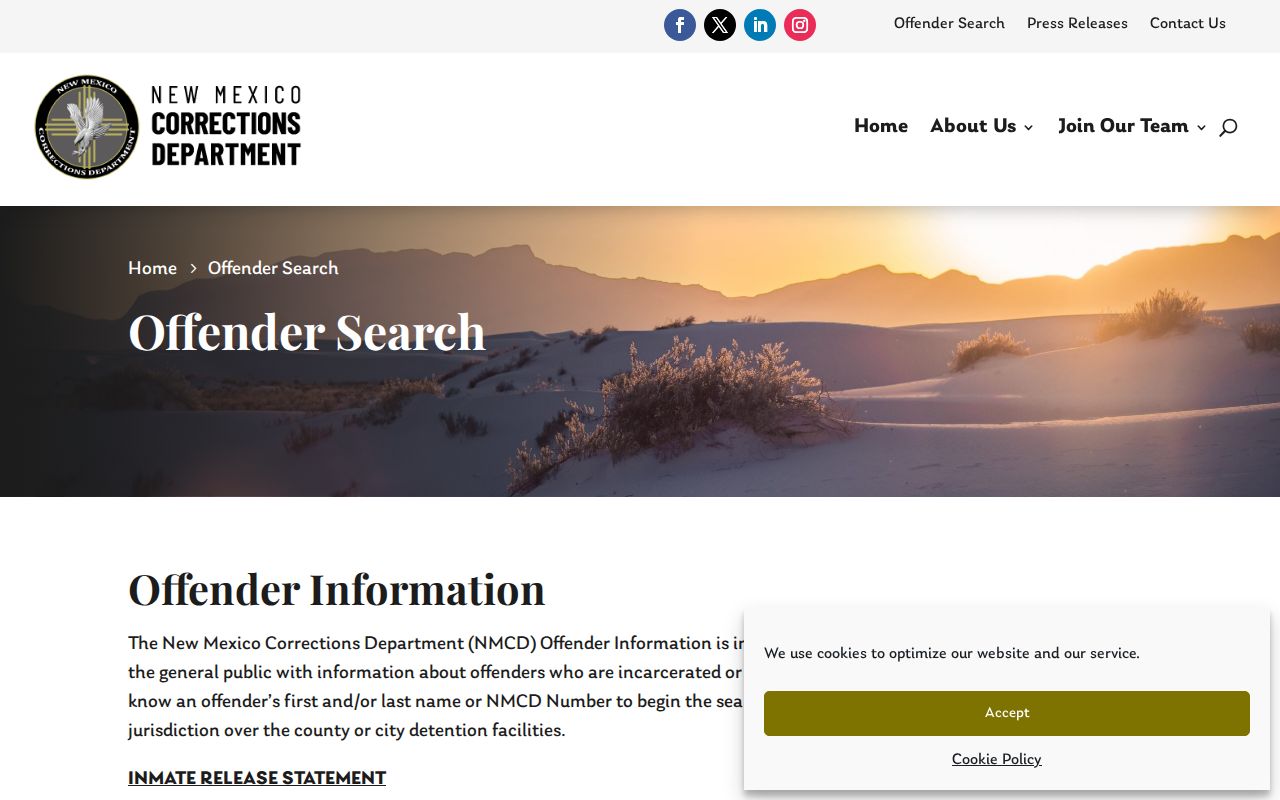
The captured NMCD notice directs users to verify movement and legal status, which is essential when a projected release date is close or a record disappears.
Santa Fe County Jail Date Inputs
Santa Fe County’s jail calculation is unusually well described in its 2025 Jail Management System procurement. Staff process court release orders and sentencing updates, scan for warrants and holds, calculate sentences, and use a physical release board. The working data include sentence start dates, time served, earned credits, and scheduled release dates. Staff must also audit paper and digital files and clear detainers.
A case-number mistake or missing file can delay processing. A corrected order can change the legal term. A detainer can prevent community release after one case ends. These are operational facts from the county procurement, not proof that every field is public in Archonix. Some items in the document describe desired future software, including adjusted projections, reason codes, signoffs, and automated checks.
For a county sentence, request existing records rather than asking the custodian to perform a new calculation. Useful items include the judgment, jail sentence calculation, time-served entry, scheduled-release entry, release authorization, hold or detainer record where public, and final release summary. The Santa Fe County IPRA portal is the written route for Corrections records.
Note: The Santa Fe County Sheriff does not operate the jail, so direct jail calculation requests to County Corrections rather than Sheriff Records.
New Mexico Earned Release Deductions
NMSA 1978 § 33-2-34 governs earned meritorious deductions for NMCD prisoners. After presentence confinement is credited and the person enters NMCD, the current maximum is four days per month for a serious violent offense and thirty days per month for a nonviolent offense. Classification under the statute matters. Active participation, loss or restoration of deductions, parole-revocation confinement, and approved lump-sum awards can also affect the figure.
Earned deductions are not the same as credit for time served before sentencing. Presentence credit comes from the judgment and custody record. Deductions operate within the state statute after admission to NMCD. Life and life-without-parole sentences are not reduced through the ordinary deduction method. Never apply the monthly rates to a Santa Fe County pretrial detainee.
A historical proof request to NMCD can seek the judgment and commitment, parole-eligibility and release dates, actual prison-release status, and good-time figuring sheet. NMCD policy treats several of those categories as public, though protected material may be withheld or redacted. The department’s NextRequest portal is its regularly monitored online IPRA channel.
NMCD also states that Central Office, Constituent Services, and the Records Bureau will not provide release updates or statuses. For an approaching state-prison date, its FAQ directs family questions toward the facility Classification Officer. NMCD Victim Services has a distinct projected-date role within its published scope.
Why Santa Fe Release Dates Change
A release date can move because the law, the factual inputs, or the person’s status changed. It can also appear wrong because a data entry or case-number problem delayed processing. Read the cause from an official record instead of estimating a new date from the original sentence.
| Event or input | Effect on the release date |
|---|---|
| Corrected judgment or sentence | Changes the legal term or its structure |
| Presentence confinement credit | Changes the amount of time remaining |
| Earned or lump-sum deductions | May advance the endpoint within § 33-2-34 |
| Loss or restoration of deductions | Can move the projection later or earlier |
| Hold, warrant, or detainer | May block community release when one case ends |
| Parole plan or unsigned conditions | Can prevent physical parole release under § 31-21-10 |
| Life-sentence parole decision | Controls release after eligibility review |
| Transfer or out-to-court event | Changes location but does not end custody |
| Case-number or file mismatch | Can delay processing and mislead a public screen |
Parole eligibility is not a promised date. For many determinate New Mexico terms, mandatory parole follows the custodial term under NMSA 1978 § 31-21-10, but an approved plan and signed conditions can be required before physical departure. Life cases and special statutory categories follow other procedures.
Santa Fe 86.85 Percent Rule
New Mexico’s familiar “85 percent” shorthand is not exact. Section 33-2-34 permits no more than four days of earned deduction per month for a serious violent offense. The New Mexico Supreme Court’s discussion in State v. Rudolfo explains that this produces service between 86.85 percent and 100 percent, not a fixed 85 percent.
This distinction changes how a projected date should be discussed. The low end assumes the maximum deduction is earned and retained. The high end reflects no such reduction. Offense classification and lawful award, loss, or restoration rules remain part of the real calculation. A simple sentence multiplied by 0.85 is not an official New Mexico release date.
Santa Fe County adds a local process risk. Its procurement describes manual sentence calculations, a physical release board, credits, changing court orders, file review, holds, and detainers. Those facts explain why even a sound estimate must be checked against the current jail record. They do not authorize anyone outside the agency to recompute the date.
The NMCD live search form shows the fields available for locating the state record.
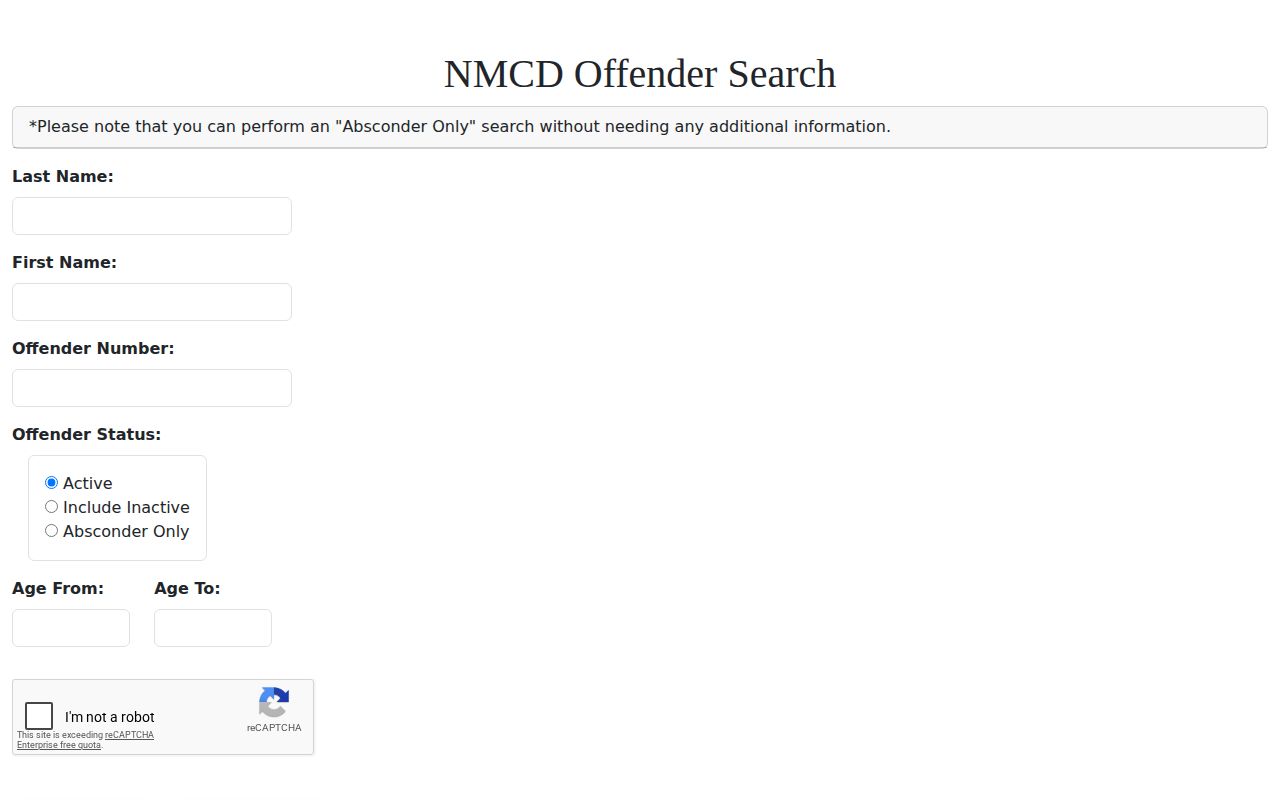
The state form helps match an NMCD record, but the exact date label on the person’s detail must still be read and verified as displayed.
Confirm Santa Fe Projected Release
Use more than one record near the date. For a county sentence, compare the judgment with the jail’s scheduled-date calculation and final release summary. For PNM or another state prison, compare NMCD’s current result with the sentence, earned-deduction record, parole information, and institution verification. Federal custody requires the federal locator and sentencing court instead.
New Mexico VINE can provide a pending release or custody-change alert when the relevant record participates. It is a notification system, not the calculation sheet. NMCD’s page carried a service-upgrade notice on July 29, 2026, so check present availability and preserve any alert. The Santa Fe VINELink inmate search describes registration, transfer re-registration, and the state-service caveat.
If historical proof is needed, make a narrow written request. Ask Santa Fe County Corrections for records sufficient to show the scheduled and actual county release. Ask NMCD for the good-time figuring sheet and existing eligibility, release, or discharge documents tied to the NMCD number. Request electronic records where maintained.
A focused Santa Fe County request should identify the full booked name, date of birth if known, booking number, and approximate booking date. Ask for the judgment or court order received by Booking, the sentence calculation, credited time, scheduled date, hold or detainer entries where public, release authorization, and the final release date and time. Requesting named existing records helps the custodian locate the right episode. It also prevents a projected value from being mistaken for the event that closed the stay.
For a state prisoner, use the NMCD number and name the existing records sought. A good-time figuring sheet documents the credits used in the computation. A release or discharge record documents the later event. Confidential reports, victim information, medical material, protected addresses, and security information may be withheld or redacted. A public date can still be supplied without opening the entire correctional file.
Do not treat disappearance from either portal as release. NMCD warns that technical problems can cause a former result to vanish. The county gateway also calls its data reference-only. The strongest endpoint is an actual release timestamp, transfer destination, or formal discharge record from the agency that created it.