
Santa Fe County Release Paths
A release closes or changes one custody episode. At the Santa Fe County Adult Correctional Facility, that change may be a return to the community after bond, dismissal, a court order, time served, or a county sentence. It may also be a move to electronic monitoring. Other departures lead to a tribal authority, another jail, the New Mexico Corrections Department, the U.S. Marshals Service, BOP custody, or immigration custody. The event type and destination matter as much as the date.
Santa Fe County Corrections operates the adult jail. The Sheriff’s Office does not operate it, and NMCD does not own its booking records. By contrast, the Penitentiary of New Mexico is an NMCD state prison. Two facilities sit on the same broad NM 14 corridor, yet their released-person records are held by different agencies. A current roster proves only that a person was listed in custody when the source updated. Disappearance proves none of the possible outcomes by itself.
Santa Fe County Release Types
The words used on a release record should be copied exactly. “Parole” is not a synonym for probation. “Time served” is not the same as dismissal. An out-to-court movement or hospital trip may be temporary. Even release on one charge may leave another hold in force.
| Event | Meaning | Next confirmation |
|---|---|---|
| Bond or recognizance | The person leaves pretrial custody under court terms. | Jail release record and bond or release order |
| Time served | The custodial part of the sentence has been completed. | Judgment, sentence calculation, and release time |
| Electronic monitoring | The person leaves secure custody for a court-directed county program. | Court order and county program record |
| Transfer to NMCD | County custody ends while state incarceration begins or continues. | County transfer record and NMCD result |
| Parole | A state prisoner leaves confinement under conditions. | NMCD supervision record and Parole Board material |
| Federal or tribal transfer | Another authority receives the person. | Receiving agency locator, docket, or record |
A death, temporary medical move, or remand requires careful source-specific language. It should not be described as an ordinary release. A detainer is a request or legal basis for another authority to take or keep custody. It can prevent a court order in one case from producing actual community release.
Santa Fe County Release Record Fields
The strongest county record ties a named person to one booking episode and explains the departure. Santa Fe County does not publish a full data dictionary for Archonix, so these are focused request fields, not a promise that each appears under the same label online.
| Field | What it establishes |
|---|---|
| Booked name, aliases, inmate number | Which person and county record are involved |
| Booking number and booking time | The exact jail episode |
| Charges and case numbers | The court matters tied to custody |
| Release date and time | When the processed departure occurred |
| Release type or disposition | Bond, court action, time served, transfer, or another event |
| Authorizing court or agency | Who supplied the legal basis |
| Destination or receiving agency | Whether the person went home or stayed in custody elsewhere |
| Holds or detainers at departure | Why one case ending may not create freedom |
| Booking photograph | The official image associated with that episode |
Not all fields will exist as separate database values. Security, juvenile, medical, victim, or protected personal information may be withheld or redacted. Asking for “records sufficient to show” the booking and release event allows the custodian to produce an existing release summary, status history, transfer sheet, or similar record without being asked to create a new answer.
Request Santa Fe County Release Records
The Santa Fe County public-records page routes Inspection of Public Records Act requests. Direct a jail request to Corrections and the Adult Detention Facility. A Sheriff arrest report follows the Sheriff Records route instead. Written requests receive the statute’s formal process, and they must identify records with reasonable particularity plus the requester’s name, address, and telephone number.
- Identify the full booked name, known date of birth, inmate or booking number, and approximate booking date.
- Ask for the booking sheet, custody-status history or release summary, actual release time, event type, authority, destination, and booking photo.
- Request existing electronic files and native format where maintained. Ask to receive a cost estimate before fees are incurred.
- If a denial occurs, request the written legal basis and the identity of responsible personnel.
- Compare the response with the controlling court order and the receiving agency if the event was a transfer.
IPRA calls for inspection immediately or as soon as practicable. If records are not available within three business days, the custodian should explain in writing when inspection or a response will occur. The ordinary outer response period is fifteen days, subject to the Act’s rule for an excessively burdensome request. The general paper-copy ceiling is one dollar per page for sheets no larger than 11 by 17 inches unless another law sets a fee. Electronic format should be requested when it already exists.
The official county request screen shows where the custodian instructions begin. Open the county IPRA source before reviewing the captured form below.
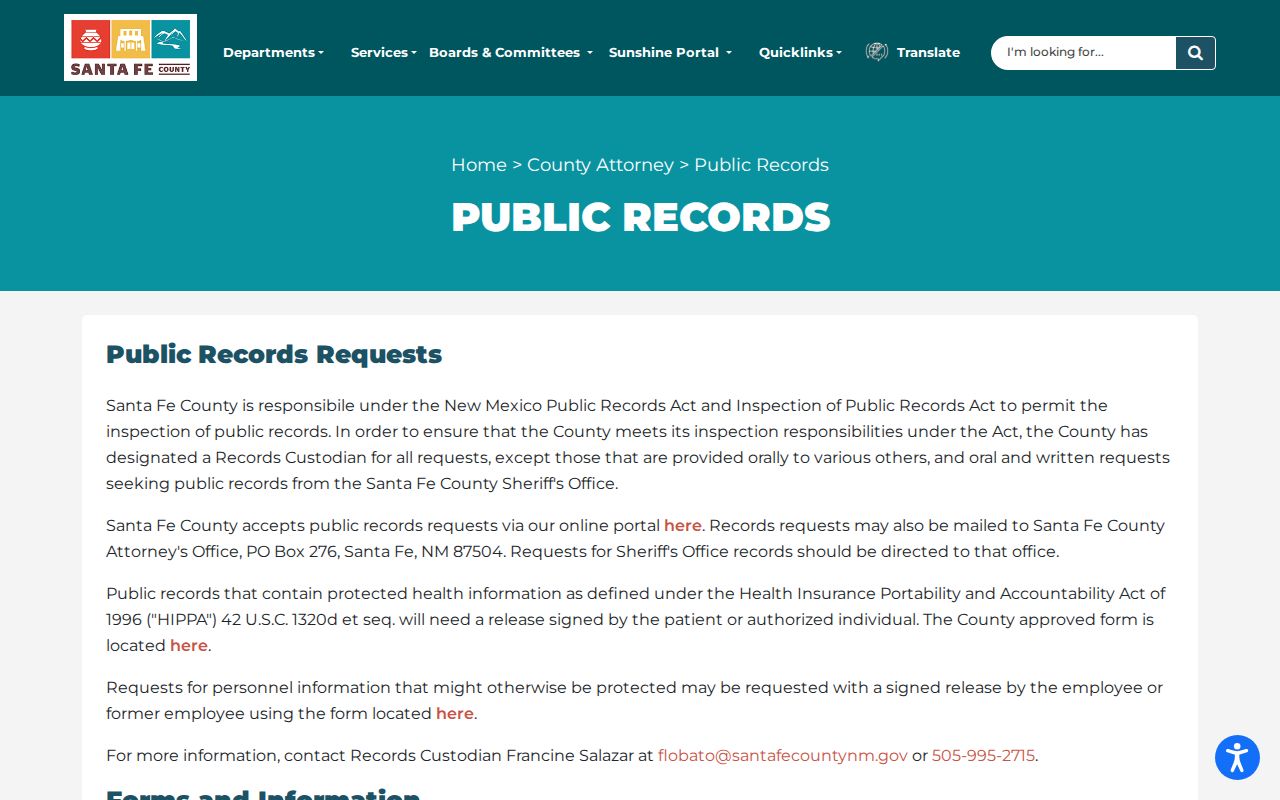
The capture is a routing aid. The written request still needs the exact booking episode and desired release fields.
New Mexico Release Record Law
New Mexico IPRA guidance explains the right to inspect public records subject to specific exemptions and other confidentiality law. Jail release records are not excluded as one entire class, but protected portions can be redacted. Santa Fe County’s schedule PSD-130-V01 treats booking files as a series that includes booking and release material. Its agency retention rule outlives a same-day screen, though retention is not the same as public web access.
A lawful expungement can later remove eligible arrest and related public entries from general access. New Mexico’s Criminal Record Expungement Act covers qualifying arrest records, including booking photographs, after a court grants relief. Release alone does not trigger expungement. Sealing, juvenile confidentiality, and an agency’s lawful redactions are also different from a portal outage.
Can an old missing result prove expungement? No. It may reflect a display limit, technical failure, transfer, spelling difference, or legal access change. The expungement order and custodian response are the proper sources.
Find Santa Fe County Released Inmates
Begin with the system that last had custody. The county gateway and Archonix application can show whether a person remains listed and includes release-date controls plus a “Released Today” shortcut. The county calls the data reference-only. A missing result must be followed by the facility, a written record, or the destination agency.
- Enter through the official Santa Fe County inmate lookup gateway and note when the check was made.
- Use the booked name or inmate number. Do not treat “Booked Today” or the booking log as a release list.
- Request the historical county release record if the person is absent or the event is unclear.
- Follow a stated NMCD, tribal, county, federal, or electronic-monitoring destination in that authority’s system.
- Use New Mexico Case Lookup to identify the case, then obtain the actual order from the proper clerk.
- Check probation or parole separately and use VINE as an alert, not sole proof.
For a same-day group view, use the county’s “Released Today” control with its exact calendar-day limitation. A named-person inquiry belongs in this full workflow.
NMCD Released Inmate Search
The New Mexico Corrections Department Offender Search covers people incarcerated by NMCD or supervised by its Probation and Parole Division. It excludes county and city detention facilities. Search by first and last name or NMCD number, use “Include Inactive” for historical research, and read status, institution, supervision, offenses, sentences, and dates with their exact labels.
| Search control | Use | Caution |
|---|---|---|
| First and last name | Find candidates and name variants | Resolve namesakes before relying on a result |
| NMCD number | Identify the state corrections record | It is not a county booking number |
| Include Inactive | Broaden a historical or discharged search | Public retention is not promised forever |
| Absconder Only | Limit an official supervision query | No result does not establish good standing |
| Region | Narrow supervision results, including Region I | Verify the assigned office |
Adult Prison Division data update nightly, and NMCD says to allow twenty-four hours. Probation and Parole information updates in real time, but movement can still make a display stale. NMCD warns that a person’s disappearance can reflect technical problems. It also says Central Office, Constituent Services, and Records Bureau do not provide release updates or statuses. The institution or assigned supervision office is the verification route.
The official NMCD scope page illustrates these limits. Review the NMCD source, then compare its language with the captured page.
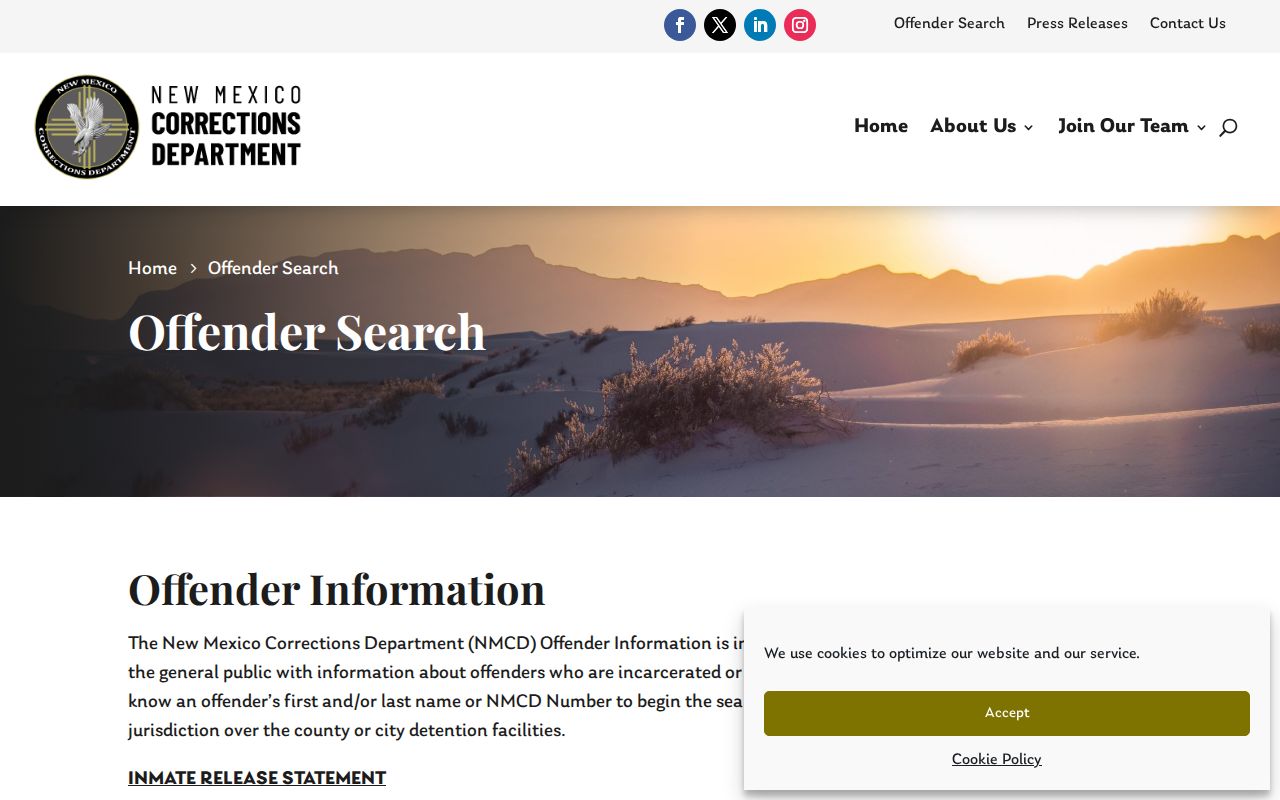
The screenshot reinforces why the county jail portal and the state system cannot substitute for each other.
Santa Fe Release Court Records
Court data often survives after the county roster changes. Case Lookup can identify the court, case number, charges, disposition, sentence, bond events, warrants, probation, and docket entries. It is an index, not the official document file. New Mexico Courts states that documents are not supplied through the general portal.
For Santa Fe County district matters, the First Judicial District Clerk can provide a judgment and sentence, order of release, bond order, dismissal, amended judgment, probation order, or discharge document. Magistrate and municipal matters must go to the court that holds them. A docket line shows court action, while the jail’s release time shows physical departure. Use both when timing matters.
The New Mexico Courts records request form requires the correct court selection. Its captured selector demonstrates why a county name alone is not enough.
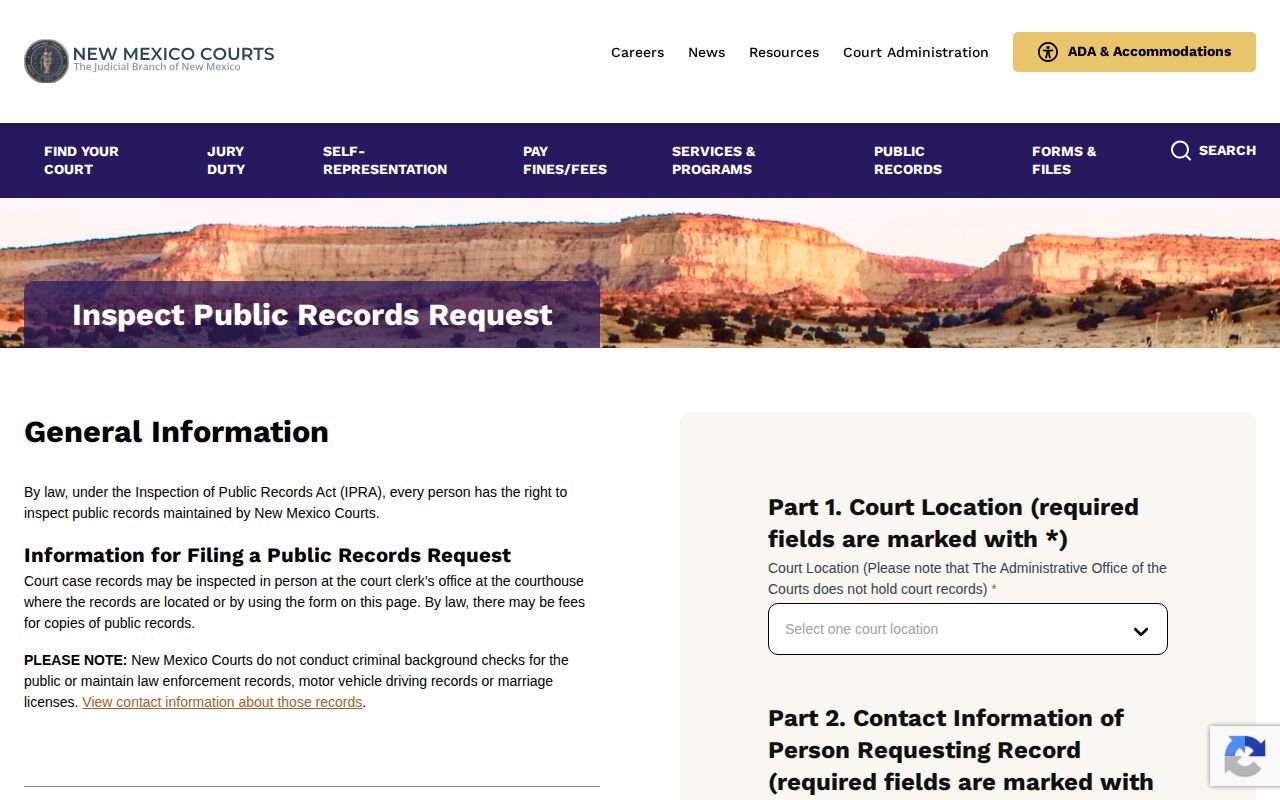
The selected court must match the docket. An order from one case also cannot rule out a hold in another.
Santa Fe County Post-Release Supervision
Parole follows a state-prison release under conditions. Probation comes from a court sentence and does not prove that the person served an NMCD prison term. Santa Fe County electronic monitoring is another distinct court-directed status. The NMCD result, controlling court order, and assigned office answer different parts of the question.
- Parole
- Conditional community supervision after state confinement.
- Probation
- Court-ordered supervision that may replace or follow custody.
- Discharge
- The formal end of a sentence or supervision obligation.
- Absconder
- A supervision status that must come from an official record, not a failed name search.
The Santa Fe Region I office and NMCD public line can verify an assigned supervision location. Court orders and Board records then show the legal basis and any final discharge.
Santa Fe County Release Support Gaps
Santa Fe’s 2025 Sequential Intercept Mapping report names Life Link Outreach, a jail reentry fair, Engage, Solace, the Rise Program and Rise House, La Sala, and Presbyterian medical-home work as parts of the local landscape. The same report identifies transportation, warm handoffs, immediate access, around-the-clock services, and a coordinated county hub as gaps or opportunities.
These findings should not be read as a promise that each person receives a placement or service at release. They are a map of existing efforts and unmet needs. The release record still answers the custody question. A program intake or supervision contact answers whether a named person is actually connected to a service.
Property After Santa Fe Release
County procurement material says property is inventoried against the custody record, and a discrepancy can delay property closeout. The facility’s mail guidance also says its Business Office handles identity documents such as birth certificates, Social Security cards, identification cards, and driver’s licenses. No public post-release pickup procedure was found.
Booking or the front desk should answer unresolved property and document questions. Do not assume that a family member may collect an item, that staff will hold it for a fixed period, or that the visitor lobby accepts personal property. Those rules were not established in the reviewed sources.
Note: An inventory or property receipt can support the closeout of a booking episode, but it does not replace the release summary.
Santa Fe Release Pickup Logistics
County meeting testimony describes a practical sequence at the Adult Detention Facility. A person is first offered a phone call to arrange pickup. A ride is offered if needed, and the person may wait in the lobby while staff becomes available. The Deputy Warden also explained that staff cannot hold a person past a verified court-ordered release time merely to wait for daylight or transportation, and staff cannot force a ride.
A recorded release time controls the custody history even if a ride arrives later. The offer of a phone call or transportation does not change the event type, and no public source promises a ride for every departure.
Getting Home After Santa Fe Release
The jail lies about fourteen miles south of Santa Fe on the NM 14 corridor. Fixed NCRTD Route 270, which once served the jail, PNM, and NMCD, was permanently suspended on October 14, 2025. The NCRTD notice points riders toward MyBlue La Cienega service. Old schedules from county testimony are obsolete. Travel plans should be checked with the current transit provider and facility before departure.
The source notice documenting the route change is captured below. It connects release planning to current transportation information rather than an outdated bus table.
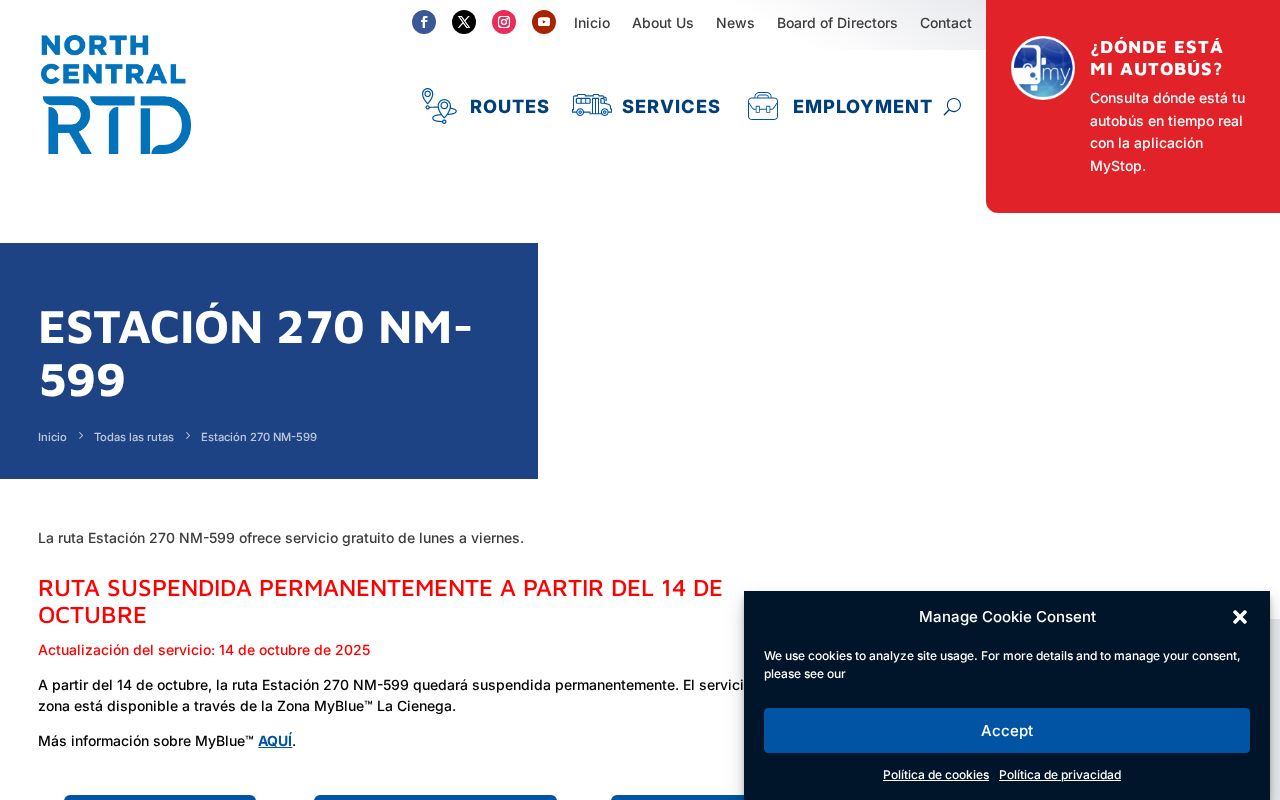
The replacement notice does not promise an on-demand ride for every jail release. Eligibility, booking, and coverage must be confirmed with the service.
Santa Fe Electronic Monitoring Release
The county’s Electronic Monitoring and Bail/Bonds Program is a court-directed alternative to secure incarceration. Adults can live at home on an approved schedule while case managers monitor compliance and report to the court. Physical departure from the jail is real, but it is not unconditional discharge.
The court order and program record should be read beside the jail departure entry. Santa Fe County’s records schedule treats bail-bond and electronic-monitoring material as a separate series from booking files. A county “release” to monitoring should not be relabeled probation unless the controlling court and NMCD records actually establish probation.
Santa Fe Federal Release Checks
The Adult Detention Facility may hold people connected to federal or U.S. Marshals matters, but Santa Fe County has no separately identified federal prison or dedicated ICE detention center. A federal detainer can make roster disappearance an interagency transfer. Use a federal source only when the booking, court, or transfer record points there.
The BOP Inmate Locator covers federal prisoners from 1982 onward. Search by federal identifier or by name and narrowing traits. A past “Date Released” with no facility location can confirm release from BOP custody, but it does not rule out state, local, immigration, or federal supervision. The captured official locator shows the federal route.
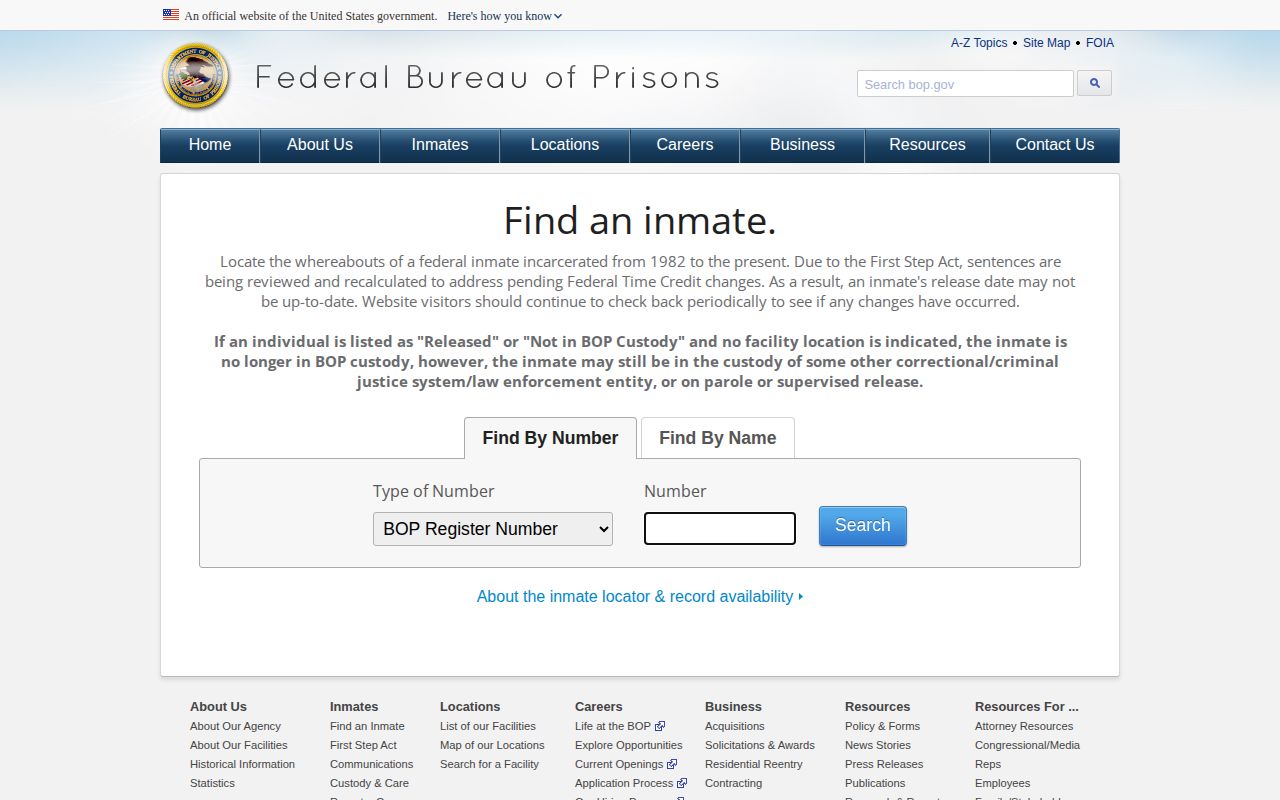
BOP wording is limited to BOP custody. Federal court records supply detention orders, sentences, and supervised-release terms.
The ICE detainee locator covers current detention and some people released within the prior sixty days. It is not a permanent history. A missing result can reflect spelling, birth-country data, processing, another custodian, an excluded record, or the short window. USMS has no general public released-prisoner locator, so the federal docket and focused records procedures become central.
Santa Fe Custody Status Sources
Each source answers a narrow question. Using the wrong one creates false conclusions, especially when the county jail and state prison share the same geographic corridor.
| Situation | First check | Strong confirmation |
|---|---|---|
| Still in Santa Fe County jail | County Archonix current listing | Facility booking or front desk |
| Released from county jail | Released Today or release-date search | County release summary and court order |
| Transferred to PNM or NMCD | NMCD search after update time | County transfer record plus NMCD status |
| Released from state prison | NMCD inactive and supervision search | NMCD release record and any Board discharge |
| Federal prison episode | BOP locator | BOP record and federal docket |
| Recent ICE episode | ICE locator | ICE documentation or responsible office |
Save exact labels, the date and time checked, and the identifier used. County booking numbers, NMCD numbers, BOP register numbers, A-numbers, and court case numbers are not interchangeable.
Santa Fe County Release Facilities
Two adult detention facilities require separate release paths. The county jail is a local booking and pretrial facility. PNM is a state prison for sentenced NMCD prisoners.
- Santa Fe County Adult Correctional Facility: confirm community release, electronic monitoring, or transfer through the county release record.
- Penitentiary of New Mexico: check statewide NMCD incarceration, parole, and discharge records rather than the county roster.
Youth programming and electronic monitoring do not receive separate facility pages because neither is an adult detention building in this project.